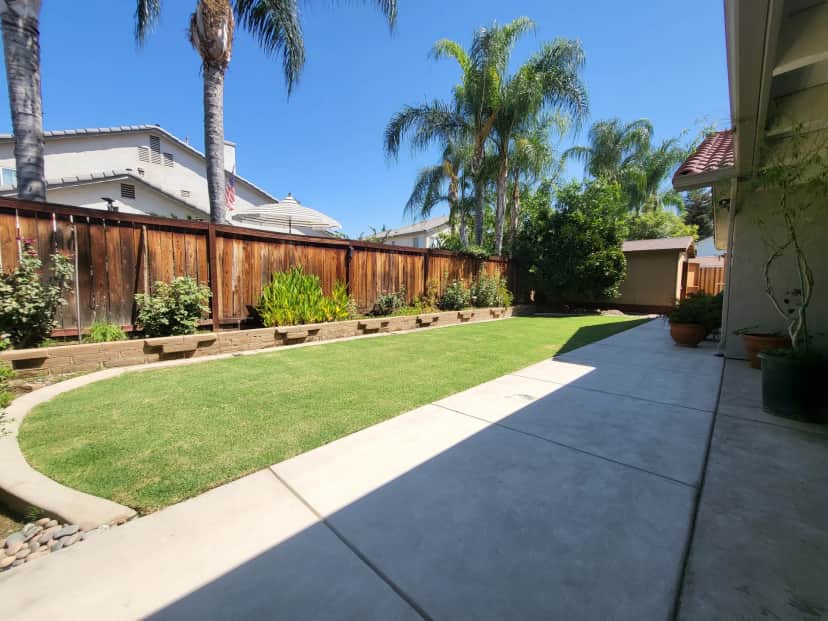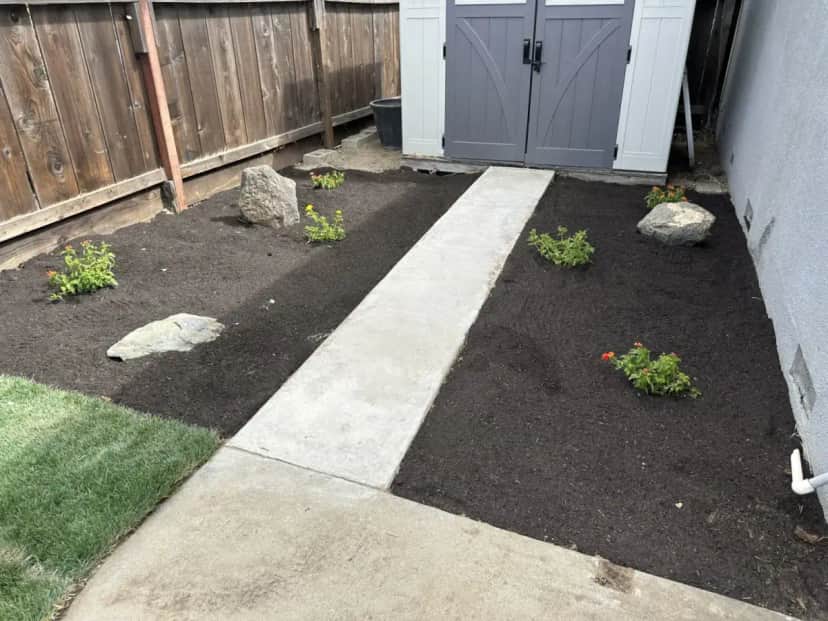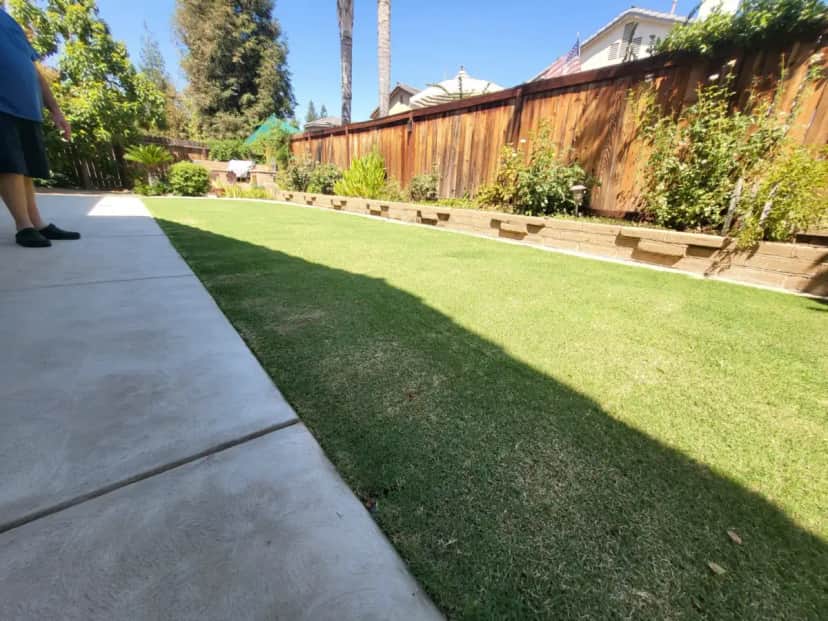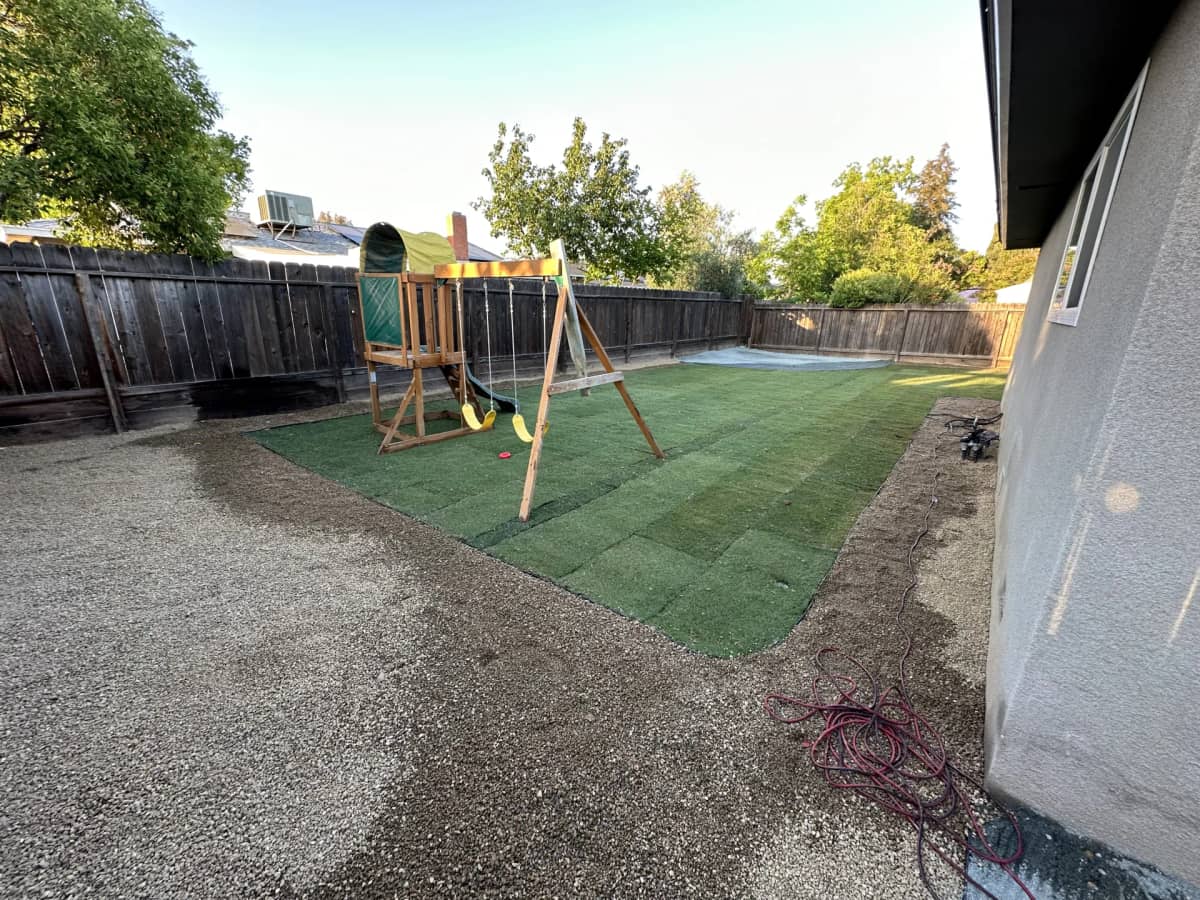
You've got a dog, and your lawn has round yellow spots that keep showing up no matter how much you water. Some of them have a bright green ring around the edge. If that sounds familiar, you already know what's happening to your lawn: it's dog urine, not a disease, not a bug, and not your sprinklers. We see it every week in backyards across Kerman, Fresno, and Clovis, and the good news is that it's one of the most preventable lawn problems there is.
Dog pee is basically liquid fertilizer that's way too strong. Diluted, it feeds the grass (that's the green ring). Concentrated in one puddle, the nitrogen and salts burn it (that's the dead center). Fix: dilute it fast, give the dog a spot of their own, and keep the lawn hydrated so it can take the hit.
Why dog pee kills grass
Urine is loaded with nitrogen and salts. Nitrogen is the main ingredient in lawn fertilizer, and that's exactly the problem: a single puddle of dog urine drops more nitrogen on a few square inches than a whole bag of fertilizer would put on your entire lawn. The grass in the middle of the puddle gets chemically burned, the same way over-fertilizing scorches a lawn. Around the edges, where the urine soaked in thin and diluted, the grass gets a perfect dose and turns extra green.
A few things people get wrong:
- It's not the acidity. Dog urine pH is close to neutral. Tomato juice, baking soda and "pH balancers" do nothing for the lawn (more on myths below).
- It's not a "female dog" or "big dog" problem. It's a volume in one spot problem. Female dogs and puppies squat and empty the whole bladder in one place, so they leave classic round spots. Males who lift a leg spread smaller amounts around, often on shrubs and fence posts instead. Large dogs simply produce more urine per stop.
- Diet matters, but don't self-prescribe. Higher-protein diets mean more nitrogen in the urine. Only change food or add supplements with your vet's OK. Nothing sold as a "lawn saver" for dogs is proven to work, and some of it isn't great for the dog.
Why it's worse in the Central Valley
The same dog leaves worse spots in Fresno than they would in Seattle, and the reason is stress:
- Heat and drought stress. On a 105°F afternoon the grass is already fighting to hold water. A salty puddle on top of that finishes it. Spots that would grow out in a wetter climate go straight to dead here.
- Watering-day limits. With most of our cities on a 3-day schedule (water restrictions guide), urine can sit undiluted for two days before a sprinkler ever touches it.
- Salty, alkaline soil. Our soil already runs around pH 8.0 with a high salt load. Urine salts stack on top of that instead of washing through.
- Grass type. Tall fescue and perennial ryegrass tolerate urine best. Bermuda burns more easily, but it's the one that heals itself, because it spreads by runners and fills a small spot back in within a few weeks of summer growth. Fescue won't fill in on its own; every fescue spot has to be reseeded or patched.
What dog spots look like: early vs. late
The pattern is the giveaway. Here's how a spot progresses if nothing is done.
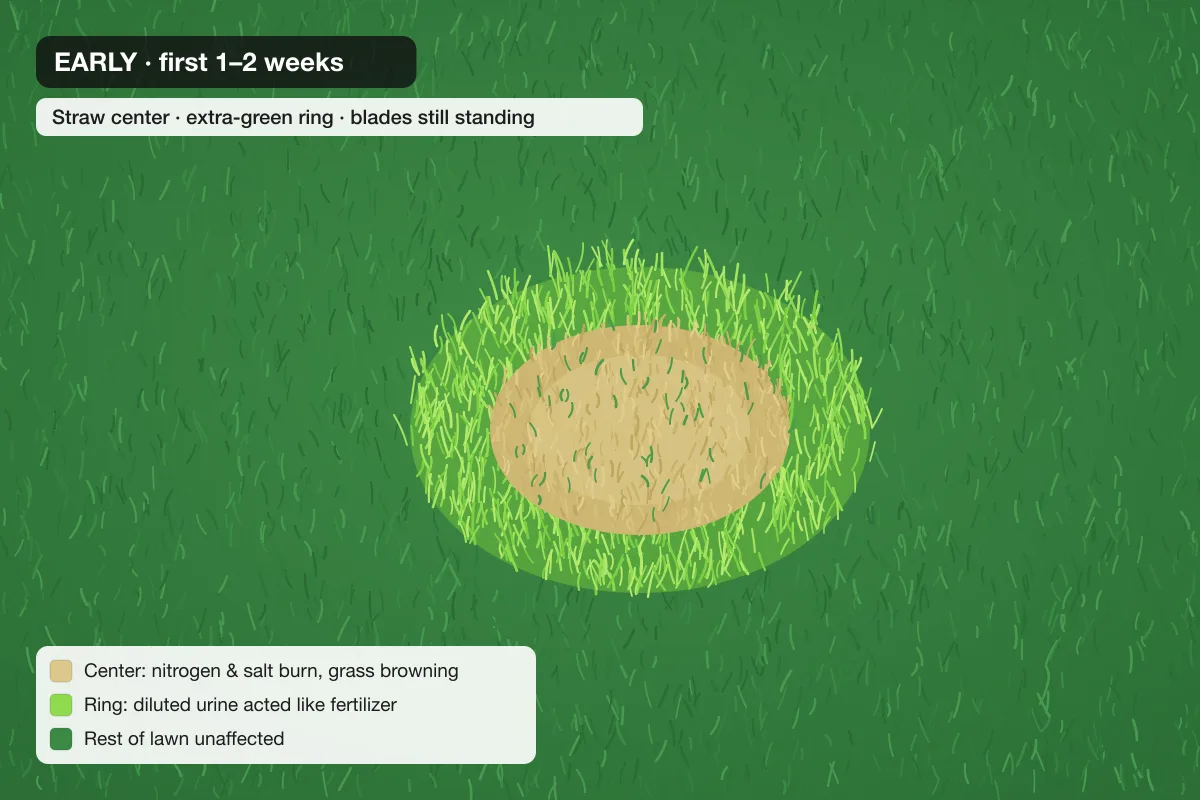
Straw center, green ring
- Round or oval, usually 4–10 inches across
- Center turns yellow then straw-colored, but the blades are still standing
- A ring of darker, faster-growing green grass around it (the fertilizer effect)
- Clustered where the dog goes first thing in the morning, or along their favorite route
- Still saveable: flush with water now and Bermuda usually recovers on its own
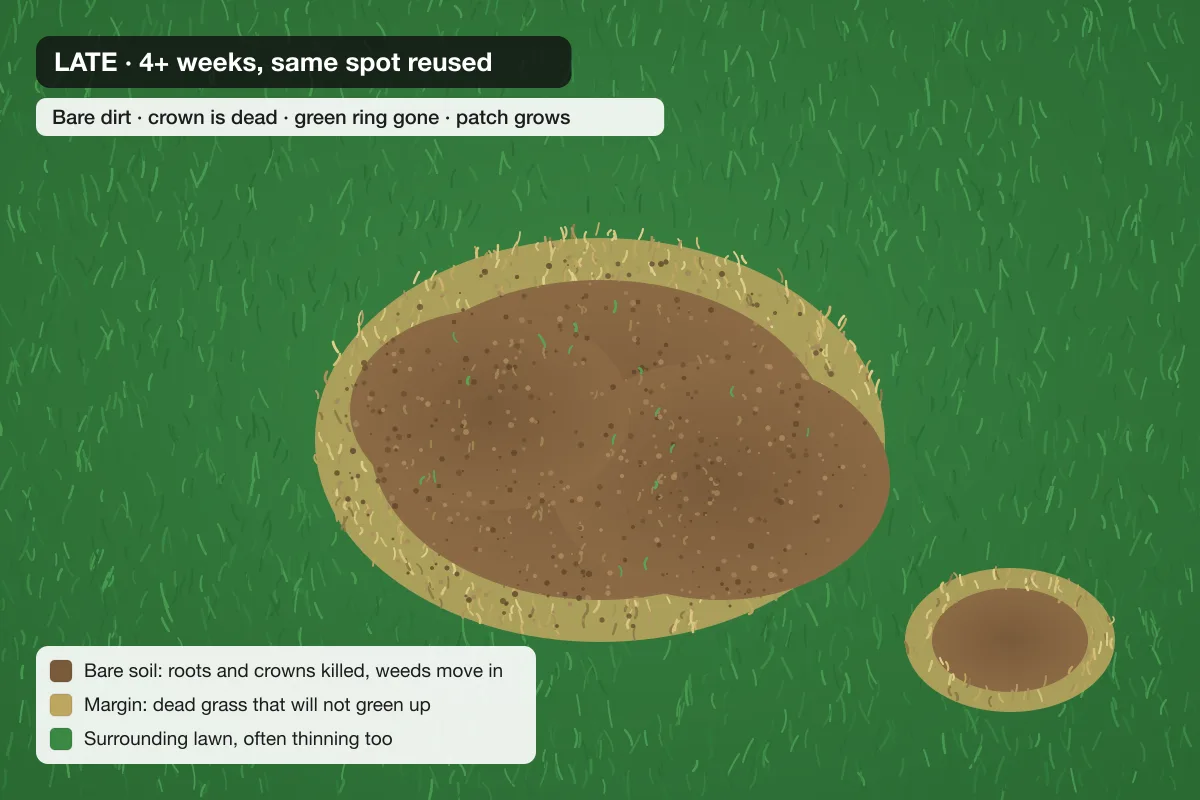
Bare dirt, no ring
- Center collapses to bare soil; the crown (the growing point at the base) is dead
- The green ring fades; the margin is dead tan grass that will not green up
- Spots merge into larger irregular patches where the dog returns to the same place
- Weeds move into the bare dirt, especially spurge and crabgrass in summer
- Needs repair: soil, seed or a sod patch, plus a change in the dog's routine
Dog spot, or something else?
Plenty of lawn problems make brown spots. Use the ring and the location to tell them apart.
| What you see | Most likely cause |
|---|---|
| Round spots with a bright green halo, near the door or the dog's usual corner | Dog urine |
| Yellow-then-brown patches with no halo, appearing after humid nights, sometimes a smoky gray edge in the morning | Fungus (brown patch) |
| Turf that lifts like a loose carpet, birds or skunks digging at night | Grubs |
| Angular dry areas that follow the sprinkler pattern, same spot every summer | Sprinkler coverage (repair guide) |
| Whole lawn pale yellow-green, not spots | Iron chlorosis from our alkaline soil (read more) |
| A neat yellow rectangle or oval with matted grass in the middle | Something sat there: a dog bed, a toy, or a pile of poop left too long |
What about dog poop?
Poop is a slower, quieter version of the same story, with a couple of extra problems:
- It smothers the grass underneath. Leave a pile for a week in July and you'll find a yellow patch of flattened, dead grass under it when you finally pick it up.
- It's not fertilizer. Dog waste does release nitrogen, but too slowly and too concentrated to help. What it does add reliably is bacteria and parasites (roundworm, hookworm, giardia, E. coli) that survive in the soil for weeks, right where kids and other dogs play. Never compost it and never leave it under the mower.
- Mowing spreads it. A mower turns one pile into a smear across a whole strip, and the smell into the whole yard. Our crews pick up before mowing, and you should too.
The fix is simple: pick up daily, or at minimum every couple of days in summer, and hose the spot afterward. That's it. The lawn recovers on its own once the pile is gone.
10 ways to prevent dog spots
The single most effective fix
Keep a watering can or a hose by the back door. Within an hour or two of the dog going, dump a gallon or so on the spot. Three times the volume of the urine is plenty. You're turning a burn into fertilizer.
A designated potty area
A 6×6 ft area of pea gravel, decomposed granite, bark mulch or artificial turf takes the lawn out of the equation entirely. Put it where they already tend to go. Walk them there on a leash, use one word, treat when they finish. Most dogs switch over in a week or two. A post or boulder helps leg-lifters aim.
Morning urine is the strongest
Overnight urine is the most concentrated of the day. Take that one to the potty area or on a walk. That one habit removes the worst spot every single day.
Dilute from the inside
Fresh water bowls inside and outside, a splash of water mixed into dry food, and a bowl in the shade during summer. More water in means weaker urine out. Skip pills, powders and "rocks" for the bowl unless your vet recommends them.
You're stacking nitrogen
Where the dog goes, the lawn is already getting plenty of nitrogen. Fertilizing that area, especially in summer, just makes the burns bigger. Feed the rest of the lawn; skip or lighten up on their corner.
More leaf, deeper roots
Taller grass has more leaf to spare and deeper roots to pull water with. Keep Bermuda at 1½–2 inches in summer and fescue at 3–4 inches. Never scalp it in the heat.
Hydrated grass takes the hit
A lawn that's already dry has no buffer. Water deeply and early on your schedule days so salts wash through, and fix the dry corners a bad sprinkler head leaves behind. Half the "dog spots" we get called about sit right on top of a coverage gap.
Bermuda heals, fescue resists
Bermuda burns a bit easier but repairs itself by spreading. Tall fescue tolerates urine better but every dead spot stays dead until you reseed it. For a busy dog backyard in our heat, Bermuda usually wins. See our Bermuda vs. fescue breakdown.
Before it smothers, before you mow
Daily in summer, at least twice a week the rest of the year. Bag it and trash it. Rinse the spot. That's the whole program.
Where the dog spends the day
If your dog is out all day while you're at work, a narrow side yard of grass will never win. Decomposed granite or pet-rated artificial turf with a drainage base turns it into a dog run that rinses clean with a hose.
Myths that waste your weekend
- Tomato juice or baking soda in the dog's food. Baking soda adds more salt to the urine, the opposite of what you want. Tomato juice just makes the dog drink more water, which you can do for free.
- Vinegar or gypsum on the spot. Vinegar kills grass. Gypsum helps some salt problems in soil but does nothing about nitrogen burn, and our soils don't need more calcium.
- "Dog rocks" and lawn-saver supplements. No controlled study has shown them to work. Save the money for a bag of seed.
- "It's a fungus, spray it." Fungicide on a urine spot is money on the ground. Check for the green halo first.
How to repair the spots you already have
Bermuda, early spots: flush the spot with a couple of gallons of water, rake out the loose dead blades, and leave it. In summer, Bermuda runners will close a 6-inch spot in two to four weeks. Keep the dog off it if you can.
Bermuda, bare spots: flush, rake to bare soil, scratch in a half inch of compost or topsoil, and either plug a piece cut from a healthy edge or seed with hulled Bermuda while soil temps are still warm. Keep it damp until it fills.
Fescue, any stage: fescue won't spread, so every spot needs seed. Right now, September through October, is the best window of the year for it in the Valley. Rake, flush, top with a half inch of compost, seed heavy, cover lightly, and keep it moist for two weeks. Our overseeding guide covers the fall timing in detail.
Many spots or a big merged patch: patch it with sod. It's instant, it takes the dog's abuse within a couple of weeks, and it's cheaper than you'd think for a few dozen square feet. If the whole back lawn is gone, that's the moment to look at a fresh sod install with a proper dog zone built in, or converting the problem area to artificial turf or decomposed granite so it never comes back.
Dog spots you can't get ahead of?
We patch and replace dog-damaged lawns every week across Kerman, Fresno and Clovis. Sod patches, full re-sods, pet-friendly artificial turf and decomposed-granite dog runs. Send us a few photos of the spots and we'll tell you honestly whether it's a water-it-in fix or a repair.
Send photos for a price →Or call or text (559) 809-1230. Ongoing lawn care customers: mention the dog spots to your crew lead and we'll flag the area, pick up before mowing, and adjust the fertilizer plan around it.